Unmarried couples in Morocco: who gets asked for a marriage certificate, and who never does
Two American partners are never asked for a marriage certificate in Morocco; the check applies when one partner is a Moroccan citizen, dual nationals included.
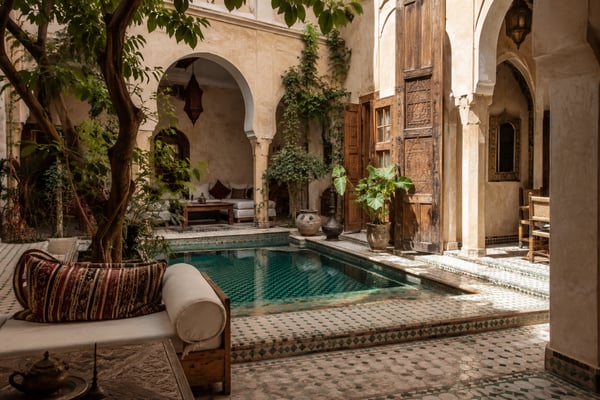
You have found the riad: a tiled courtyard, a roof terrace, one double room left for your dates. Then a forum thread tells you Moroccan hotels ask couples for a marriage certificate, and you are not married. Before you rebook anything, here is the short version: whether anyone asks depends almost entirely on the nationality of the two people checking in, not on the hotel, the city or the room. Most American couples are never asked at all.
Who gets asked for a marriage certificate in Morocco
A marriage certificate in Morocco is asked of couples in which at least one partner is a Moroccan citizen. Two Americans checking in on US passports, entering visa-free for up to 90, are not asked for one by hotels, riads or guesthouses. The check exists because Moroccan law forbids sexual relations outside marriage, and reception desks apply it to Moroccan guests, not to foreign tourists sharing a room.
That gives three situations, and they play out very differently:
Two foreign partners (two Americans, or an American and a European): no certificate, no question about it. This is the overwhelmingly common case.
One foreign partner and one Moroccan citizen: the desk will usually ask for proof of marriage, and without it many properties will not give you one room.
Two Moroccan citizens: the same rule, applied even more consistently.
The certificate itself is the acte de mariage, the Moroccan marriage record. A foreign marriage certificate may be accepted for a married mixed couple, but practice varies by property, and a certificate in English with no translation can slow things down.
What check-in looks like for two American partners
Check-in for two unmarried American partners in Morocco is the same as for any other foreign guests: each of you hands over a passport, which should have at least six months of validity left, and the desk copies the details onto a registration form. Nobody asks how you are related, and a double bed is booked and given exactly as it would be at home.
The form is the fiche de police, a guest registration that Moroccan hotels and riads fill in for every foreign guest and pass to the police. It records your name, passport number, nationality, and the date and stamp number of your arrival, which is why the desk sometimes flips to the page with your entry stamp. It is routine and applies to everyone, married or not. Our explainer on the Morocco entry stamp and passport rules covers what that stamp shows.
A few points that save small frictions at the desk:
Both partners register. Even if one of you made the booking, each adult guest shows a passport.
Booking under one name is fine. Platforms that ask for one lead guest do not create a problem; the second passport is added at check-in.
Different surnames are normal. Staff see them every day from foreign guests and do not treat them as a question.
When one partner is Moroccan or a dual national
When one partner is a Moroccan citizen, the marriage certificate question in Morocco becomes real, and it reaches dual nationals too. An American who also holds Moroccan citizenship, including through a Moroccan parent, can be treated as Moroccan at the desk, whichever passport they hand over. Morocco's 90 visa-free stay applies to the American passport, but the hotel's check follows citizenship, not the document.
In practice, what decides the outcome at a reception desk:
Which passport is presented. A Moroccan passport or national identity card makes the question near certain. A US passport alone often passes, but a Moroccan place of birth or a recognisably Moroccan name can prompt staff to ask.
The kind of property. Large international chain hotels and small foreign-owned riads differ in how strictly they apply it, but no property can promise you an exemption, and none should be asked to.
Whether you are married abroad. A married mixed couple should carry the marriage certificate, ideally with a French or Arabic translation, rather than relying on a photo on a phone.
Unmarried mixed couples realistically have two options: book two rooms, or book a self-catering apartment where no reception desk is involved. Neither changes the law; they only avoid the moment at check-in. If you are a dual national, it is worth reading our page on visas and entry for Americans as well, because which passport you enter on has other consequences.
What Moroccan law says, and how it touches visitors
Moroccan law makes sexual relations between an unmarried man and woman an offence under Article 490 of the penal code, and that article is what sits behind the hotel check. For foreign tourists, it is very rarely enforced: prosecutions overwhelmingly involve Moroccans. The US State Department rates Morocco at Level 2, and couples' rules are not what drives that rating.
Article 490 has been debated for years in Morocco, and it remains the reference point reception staff work from. What matters for a visit is the distance between the law and daily practice: a riad giving two American partners one room is not taking a legal risk, and nobody will check on you once the door is closed.
Same-sex relations are also criminalised under the Moroccan penal code. Two foreign travelers of the same sex sharing a room are, in practice, booked like any two friends travelling together, and the marriage question does not arise. Discretion in public is the norm rather than the exception, and couples generally keep affection private.
How unmarried couples should behave in public in Morocco
Unmarried couples in Morocco are not asked about their status in public, and no one asks a couple walking through a medina whether they are married. What draws attention is affection: kissing, long embraces and hand-holding in conservative areas read as out of place. Keep that private, dress modestly away from the beach, and the same Level 2 caution applies to you as to any visitor.
Holding hands is common among foreign couples in Marrakech, Fes and Essaouira and rarely draws comment, though it is better skipped near mosques and in small villages.
Kissing in public is the line. It can attract stares, comments or, occasionally, a word from police, and it is the behaviour most likely to cause an awkward moment.
Calling yourselves partners or saying nothing is fine. If a guide or a shopkeeper asks whether you are married, a simple yes or a smile is how many couples answer, and the question is usually conversation rather than a check.
Desert camps, mountain guesthouses and homestays follow the same pattern as riads: two foreigners share a tent or room without being asked. In a family homestay, simply behave as you would as a guest in a conservative relative's house.
Frequently asked questions
Frequently asked questions about unmarried couples in Morocco come down to booking, dual nationality and what to carry. The short answers: two foreign partners book one room and are never asked; a couple with a Moroccan citizen should expect the question; and every guest registers with a passport, which needs about six months of validity, at check-in.
Should two American partners say they are married to be safe?
There is no need. Foreign couples are not asked, and claiming to be married adds nothing at check-in, since the desk records your passports, not your relationship.
Will a riad refuse us if we have different surnames?
No. Different surnames are normal among foreign guests and are not treated as a sign of anything. The marriage question is about citizenship.
I am a dual US-Moroccan citizen. Can I avoid the question by showing my US passport?
Sometimes, but do not count on it. A Moroccan place of birth or name can prompt the question, and staff may ask for your Moroccan identity documents. Plan for two rooms or an apartment if you are not married.
Do we need to carry a marriage certificate if we are married?
Only if one of you is Moroccan. Two married foreign travelers are never asked for it. A married mixed couple should bring the certificate, preferably with a French or Arabic translation.
Keep planning
Not sure how it all fits together?
Pick your trip length and we'll route a real day-by-day plan.