The Moroccan Dirham: Why You Can't Get It Before You Arrive (and What to Do)
The dirham is a closed currency, so you can't buy it at home. Here's how money actually works in Morocco — ATMs, cash vs. card, tipping, and the export rule.
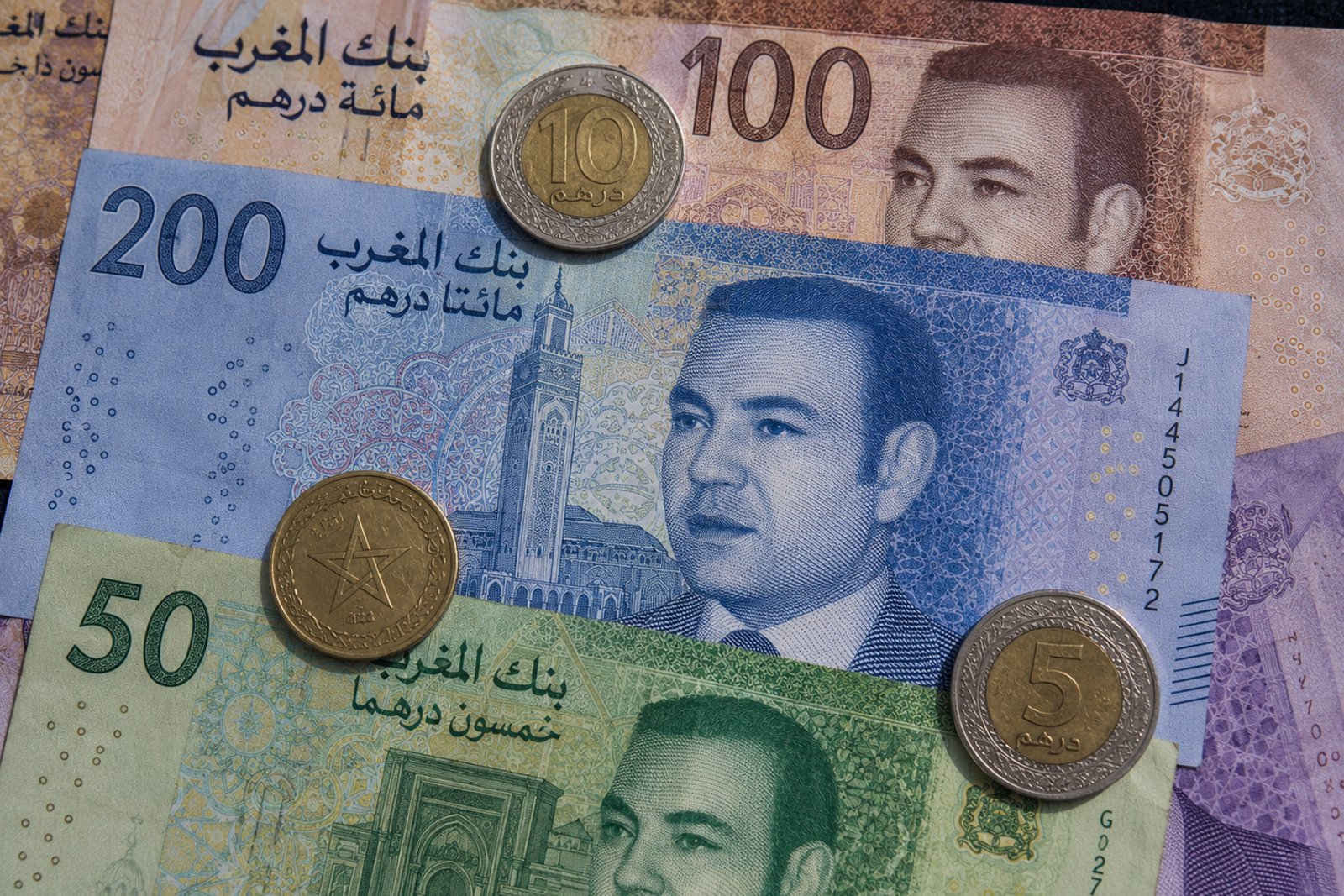
Money is where first-time visitors to Morocco most often get tripped up, and it starts before you even leave home. The Moroccan dirham (MAD) is a closed currency — you cannot buy it at your bank in the U.S. the way you'd pick up euros or pounds before a trip. That surprises a lot of travelers, so here's exactly how money works in Morocco and how to arrive prepared.
What "closed currency" actually means
A closed currency is one the government restricts from leaving or entering the country. For you, that has two practical consequences. First, you can't get dirham before you arrive — no ordering it from your bank, no exchange desk at your home airport. Second, you can't take much of it home: the export limit is 2,000 MAD, and exceeding that is actually against the rules, not just something to declare. So the game is simple — get dirham when you land, and spend it down before you leave.
How to get dirham when you arrive
ATMs are your best bet
The easiest way to get cash is an ATM, and there are ATMs right in the arrival halls at Casablanca (CMN) and Marrakech (RAK) airports. Withdraw from machines attached to major banks — Attijariwafa, Bank of Africa (BMCE), Banque Populaire, or CIH — and you'll get the official rate automatically. Tell your bank you're traveling so your card isn't frozen, and expect a per-withdrawal cap that can feel low, so you may make more than one withdrawal over a trip.
Exchange bureaus
You can also exchange U.S. dollars (bring clean, untorn bills) at licensed bureaux de change — look for the official Bank Al-Maghrib certification. Keep your exchange receipts: you'll need them to convert leftover dirham back to dollars at the airport when you leave.
What's the exchange rate?
The dirham's exchange rate moves daily, so this page never prints a fixed number — the converter below carries today's rate. For a mental model before you land: a mid-range restaurant main sits around 90 MAD and a short petit-taxi ride around 25 MAD, and every price on this site shows today's dollar equivalent beside it.
100 USD ≈ … MAD (enable JavaScript for the live rate)
As a rough mental model, a mid-range restaurant main might run you around 90 MAD, and a short petit-taxi ride in the city something like 25 MAD. The site shows today's dollar equivalent next to each so you always know what you're actually spending.
Cash vs. card in Morocco
Morocco runs heavily on cash. Souks, taxis, small cafes, and anything in rural areas or the desert are cash-only, full stop. Cards (Visa and Mastercard) are accepted at hotels, upscale restaurants, and modern city shops — but the moment you step into a medina, you'll want dirham in hand. Carry a mix of small notes and coins; vendors rarely have change for big bills, and small change is essential for tips and taxis. For a full budget breakdown in dollars, see our Morocco trip cost guide.
Avoiding the money traps
A few small habits keep more of your dollars in your pocket. When an ATM or card machine asks whether to charge you in dollars or dirham, always choose dirham — the "pay in USD" option (called dynamic currency conversion) bakes in a worse rate. Skip the exchange counters at your home airport entirely, since you can't get dirham there anyway, and avoid changing money on the street, which is both illegal and a common way to get shortchanged or handed old notes. Stick to bank ATMs and certified bureaux. And bring a backup card stored separately from your main one; if a machine eats a card or your bank flags a withdrawal, you don't want to be cardless in a cash country.
Tipping in Morocco
Tipping is expected but modest. In restaurants, around 10% is normal if a service charge isn't already added. For taxis, round up. Small tips of roughly 5 to 20 dirham are appreciated for guides, porters, and hammam attendants. It adds up to very little and smooths countless small interactions.
The practical upshot is to keep a stash of small notes and coins on you at all times — 5, 10, and 20 dirham denominations especially. ATMs tend to dispense larger bills, and a common frustration is standing in front of a parking attendant or a stall holder with only a 200-dirham note and no way to break it. Early in your trip, break big bills whenever you get the chance: buy something small at a supermarket or cafe that takes cards but pay cash, and bank the change. A pocket of small notes is the quiet secret to smooth days in Morocco.
Before you fly home: spend it down
Because you can't take dirham out (beyond that 2,000 MAD limit) and it's hard to exchange abroad, aim to spend your remaining cash before departure — the airport duty-free is a fine place to offload coins. If you have a larger amount left and kept your exchange receipts, you can reconvert dirham to dollars or euros at the airport bureau before you go through passport control.
One tip that saves the arrival scramble
Because you'll land without any local cash, it helps to arrive already connected. An eSIM activated before you fly means you have maps and can arrange a ride the moment you touch down, before you've even hit the ATM. It removes the one genuinely awkward moment of a Morocco arrival — needing to get somewhere before you have a single dirham in your pocket.
The closed currency is the first domino rather than a curiosity. It decides what you carry on arrival, and what you carry shapes how the rest of the trip is paid for. the complete Morocco trip guide follows that chain from the arrival hall to the last day.
Morocco money FAQ
Can I get Moroccan dirham before I travel?
No. The dirham is a closed currency and isn't sold outside Morocco. Withdraw it from an ATM on arrival or exchange dollars at a licensed bureau once you're there.
Should I bring cash or rely on cards in Morocco?
Bring a card for ATMs and hotels, but plan to use cash for most day-to-day spending — souks, taxis, and small cafes are cash-only.
Can I take dirham home as a souvenir?
Only up to 2,000 MAD, and it's hard to exchange abroad, so it's best to spend your dirham before leaving or reconvert it at the airport.
Are U.S. dollars accepted in Morocco?
Not really for everyday spending — a few upscale, tourist-facing places may take them at a poor rate. Exchange dollars for dirham and pay in local currency.