How Much Does a Trip to Morocco Cost? A Dollar-by-Dollar Breakdown
Morocco can be a bargain or a splurge. Here's a realistic dollar breakdown for first-time American travelers — flights, riads, food, transport, and daily budgets.
One of the best things about Morocco is how far your dollar stretches — but "cheap" depends entirely on how you travel. You can do Morocco on a shoestring or turn it into a luxury escape, and both are legitimate. This breakdown gives first-time American travelers realistic numbers so you can build a budget that fits the trip you actually want.
The big cost: flights
Your single largest expense is almost always getting there. Round-trip fares from the U.S. to Casablanca swing widely by season and how far ahead you book, so we don't print a fixed number — check live fares for your dates. Royal Air Maroc flies nonstop from JFK and Washington-Dulles; from most other U.S. cities you'll connect through a European hub or through Casablanca. Booking a couple of months out and traveling in shoulder season keeps this down. Our flights guide covers routes and timing.
Daily budgets on the ground
Daily costs inside Morocco are low by American standards. The realistic per-person range runs from roughly $40–70 a day at the budget end to $250 and up at the luxury end, excluding international flights. What moves you between those bands is where you sleep and how you travel between cities — far more than what you eat. The bands in detail:
Budget: roughly $40–70/day
Simple riads or guesthouses, street food and local cafes, trains and shared grand taxis. Very doable, and you don't sacrifice the experience — some of the best food in Morocco is cheap.
Mid-range: roughly $90–160/day
A comfortable mid-range riad, a mix of nicer restaurants and casual spots, the occasional private transfer or guided day. This is where most first-timers land, and it buys a genuinely lovely trip.
High-end: $250+/day
Luxury riads, a private driver-guide, fine dining, and desert camps with real comforts. Morocco does luxury beautifully and still for less than the equivalent in Europe.
Use the converter to sanity-check any local price you see against dollars:
100 USD ≈ … MAD (enable JavaScript for the live rate)
What things actually cost
Concrete anchors help more than averages. A tagine at a casual restaurant runs around 70 MAD, a pot of mint tea a couple of dollars, a short petit-taxi hop about 25 MAD, and a second-class train from Marrakech to Casablanca roughly 140 MAD. The site shows today's dollar equivalent beside each figure:
A tagine or main at a casual restaurant runs around 70 MAD. A pot of mint tea is a couple of dollars. A short petit-taxi hop across town is about 25 MAD. A second-class train from Marrakech to Casablanca is roughly 140 MAD. A guided half-day in the medina or a group desert tour varies widely, but street food and local transport keep everyday spending tiny. For the full money picture — including why you can't get dirham before you arrive — see our dirham guide.
Where to stay: the biggest lever
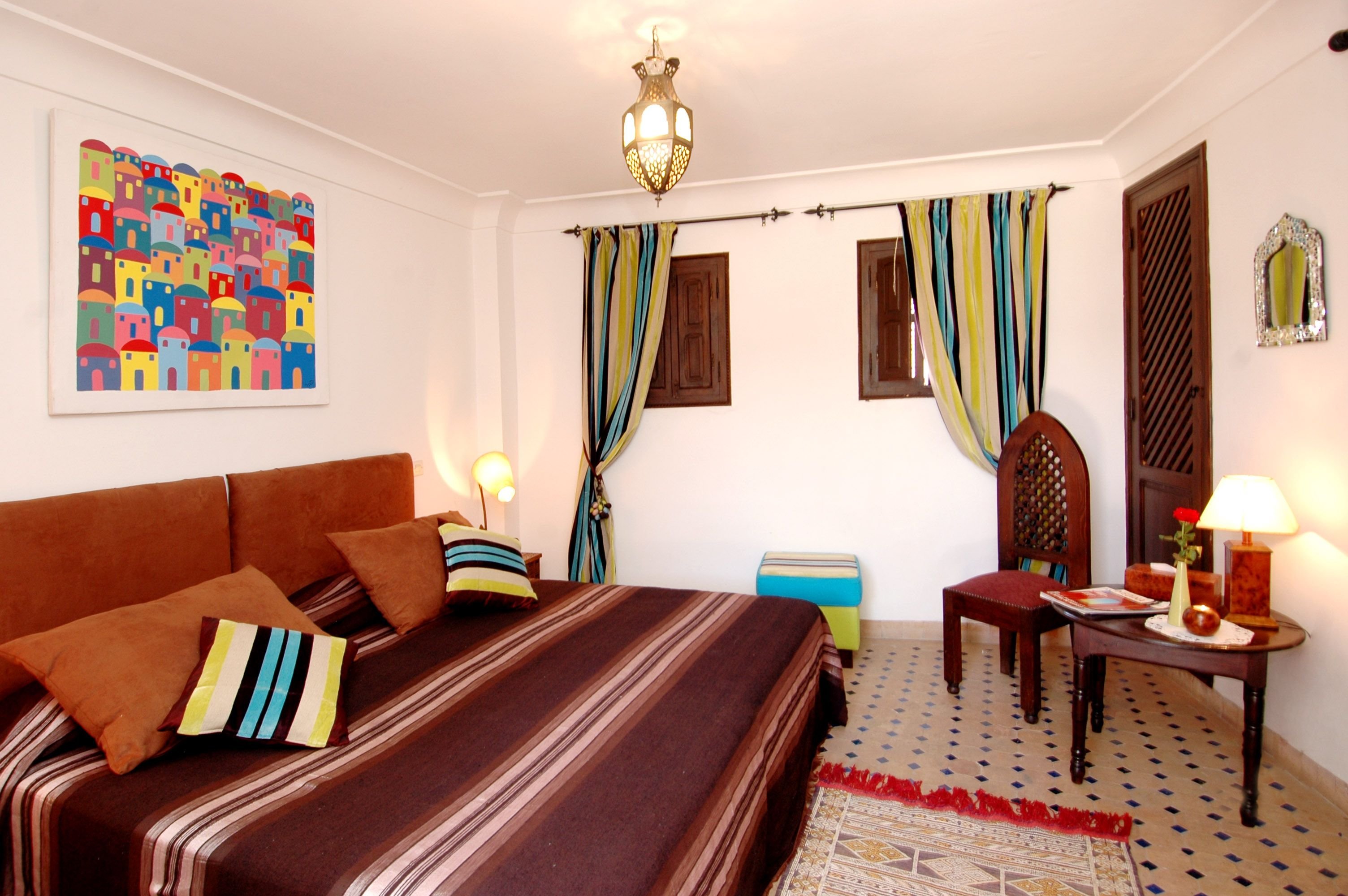
After flights, accommodation is the cost you control most. A simple medina riad can be genuinely affordable; a restored-palace riad is a splurge. Because riads are small and the best ones book up, reserving early gets you both better prices and better rooms. Our guide to riads explains what you're paying for.
Costs people forget to budget
A few line items first-timers overlook: tipping (small but constant — budget a bit of daily cash for guides, porters, and taxis), entrance fees to palaces and gardens, a multi-day desert tour if you're doing the Sahara (often the single biggest on-the-ground purchase), an eSIM for data, and travel insurance. None are large, but together they add up.
Budget vs. splurge: where the money goes
Accommodation is the single biggest swing in a Morocco budget: a simple medina guesthouse against a restored-palace riad can be a fivefold difference per night. Transport is the next lever — trains and shared grand taxis cost a fraction of a private driver, though a driver buys comfort and time on the long legs. Food barely moves the needle unless you eat exclusively at upscale restaurants, and activities split between free (medinas, viewpoints) and the discretionary spend of multi-day tours and private guides.
The practical takeaway is that Morocco lets you dial the cost up or down without changing the experience much. You can sleep in a beautiful budget riad, eat incredible cheap food, take the train, and still have a rich trip — or add private drivers and luxury camps and spend several times as much for extra comfort. Neither is wrong; it's about matching spend to what you personally value.
Money-saving tips that don't cost you the experience
A few moves stretch a Morocco budget painlessly. Travel in shoulder season, when both flights and riads drop and the weather is at its best. Take trains between the big cities instead of private transfers. Eat where locals eat — the food is better and cheaper. Book riads directly or early for the best rates. Withdraw larger amounts less often to minimize ATM fees, and always pay in dirham rather than dollars when a card machine offers the choice. And haggle in the souks, where the first price is never the real one — see our haggling guide. None of these dims the trip; they just keep more money in your pocket for the parts that matter.
A sample 10-day mid-range budget
To make it concrete: a mid-range 10-day trip, two people sharing, might run roughly $1,000–1,600 per person on the ground (lodging, food, transport, a desert tour, entrance fees) on top of flights. Go budget and you could do it for half that; go luxury and it climbs fast. The point is the range is wide and largely in your control — Morocco rewards both the frugal and the indulgent. Map it against our 10-day itinerary.
Budgets in Morocco are less about daily averages than about a handful of choices that each pull the total in a different direction. the complete Morocco trip guide takes those choices one by one, with the trade-offs written out.
Morocco cost FAQ
Is Morocco cheap for American tourists?
Generally yes — daily on-the-ground costs are low by U.S. standards. Flights are the main expense; food, transport, and simple lodging are inexpensive.
How much should I budget per day in Morocco?
Roughly $40–70/day budget, $90–160/day mid-range, and $250+/day for luxury, per person, excluding international flights.
What's the most expensive part of a Morocco trip?
Almost always the international flights, followed by accommodation and any multi-day desert tour.
Should I carry cash or use cards?
Both — cards for hotels and ATMs, but plenty of cash for daily spending, since souks, taxis, and small eateries are cash-only.